A premium tie is not defined by its price tag. It is defined by what happens when you wear it: it knots cleanly, the dimple holds all day, it drapes straight down your shirt instead of twisting, and it still looks new after the fiftieth wear. A cheap tie does the opposite, and you usually find out at the worst possible moment, in front of a mirror five minutes before a meeting.
This guide gives you nine checks you can do in a shop or the moment a parcel arrives, so you know whether the tie in your hand deserves a place in your wardrobe.
Why a premium tie is worth it
For most men a tie is the only piece of colour and pattern in a formal outfit. The suit is navy or grey, the shirt is white or blue, and the tie does all the talking. That is exactly why quality shows. A well-made tie holds a crisp knot, catches light evenly and lies flat. A poorly made one puckers, curls at the tip and makes an expensive suit look ordinary.
A premium tie also lasts. Wear a good tie twice a week and it will easily see you through several years of office days, weddings and interviews, which makes the cost per wear lower than buying a cheap replacement every few months.
9 quality checks for a premium tie
1. The drape test
Hold the tie by its narrow end and let it hang. A properly cut tie falls straight. If it twists like a corkscrew, the fabric was not cut on the bias (at 45 degrees to the weave), and it will twist on your shirt too.
2. The fabric feel
Good tie fabric feels dense and smooth, never papery or plasticky. Silk has a soft, cool hand and a gentle sheen. Quality microfibre and polyester weaves can also look and feel excellent, hold colour very well and are easier to care for in Indian humidity. What matters is density: rub the fabric between two fingers, and if you can see light through it, the knot will look thin.
3. The lining and interlining
Inside every tie is an interlining that gives it body. Too thin and the knot collapses; too thick and it becomes a lump at your collar. Squeeze the blade gently. It should spring back without creasing. Tipped ties, where the back of the tip is finished in a matching or contrast fabric, are a small sign that the maker paid attention.
4. The slip stitch
Turn the tie over and open the back seam slightly. Many well-made ties have a loose thread running along the length, called the slip stitch. It lets the tie flex when you knot it and recover its shape afterwards. A tie glued or stitched tight along its length will wrinkle permanently.
5. The bar tacks
Look for small horizontal stitches near both ends of the back seam. These bar tacks stop the seam opening under the stress of knotting. They are cheap to add, so a tie without them tells you corners were cut.
6. Width and length
A premium tie is cut in proportion. For most men a blade of 7 to 8 cm suits a standard suit lapel, and around 145 to 150 cm of length lets the tip reach your belt buckle with a four-in-hand or half-Windsor knot. Taller men or those who prefer a full Windsor should look for extra length. Our mens tie guide covers width and length in more detail.
7. The pattern alignment
On striped, checked and geometric ties, the pattern should run cleanly across the seams and meet neatly at the tip. Misaligned patterns are the quickest visual sign of rushed production.
8. The colour depth
Premium ties hold rich, even colour with no patchiness at the edges or the fold. Hold the tie near a window. Deep wines, navies and bottle greens should look saturated rather than flat. Good colour is also what lets a tie pair easily with a pocket square.
9. The finish and presentation
Check the edges of the blade for loose threads, the label for neat stitching and the packaging. A tie that arrives rolled or boxed, rather than folded into a plastic sleeve, arrives without deep creases. If you are buying the tie as a present, presentation matters twice over; see our guide to choosing a tie set for gifting.
Premium tie vs ordinary tie at a glance
| Feature | Premium tie | Ordinary tie |
|---|---|---|
| Cut | Cut on the bias, hangs straight | Often cut straight, twists |
| Body | Springy interlining, holds a dimple | Thin or stiff, knot collapses or bulges |
| Construction | Slip stitch and bar tacks | Glued or tightly machine-stitched seam |
| Pattern | Aligned across seams and tip | Misaligned at joins |
| Lifespan | Years of regular wear | Wrinkles and shines within months |
How to style a premium tie
- Business meetings: navy, burgundy or bottle-green ties with small geometric or textured patterns project confidence without shouting. Try the wine textured tie set.
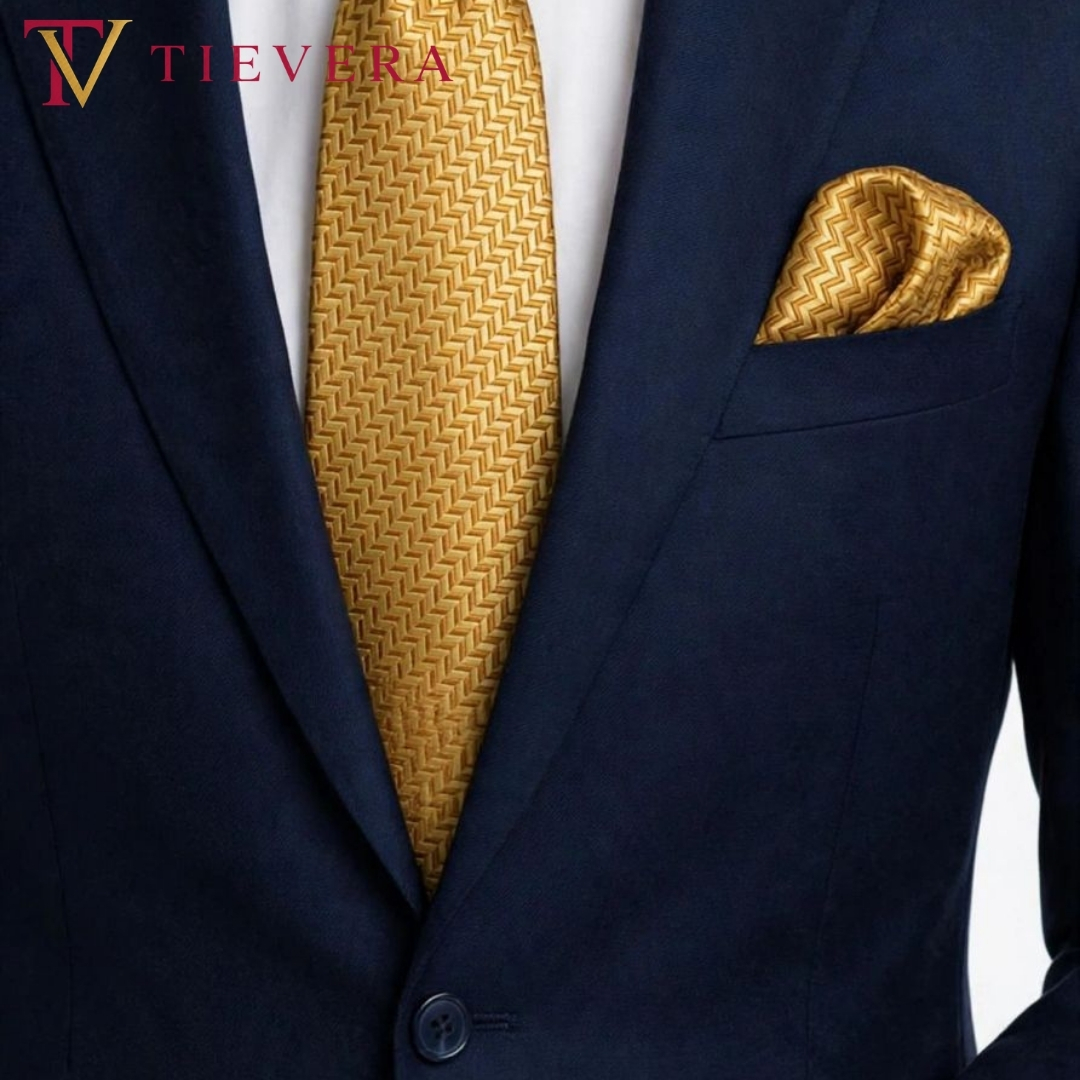
- Weddings and receptions: gold, maroon and rich jewel tones look right under evening light. The golden herringbone set is made for exactly this.
- Interviews: keep it simple. A solid or subtly textured tie in navy or deep blue works for almost every industry.
- Evening events: darker grounds with a contrasting stripe, such as the brown and black diagonal striped set, add depth under artificial light.
Finish the look with a pocket square that complements rather than copies the tie. Our guide on how to match a tie and pocket square explains the rules.
How to care for a premium tie
- Always untie the knot fully. Pulling the narrow end through a tied knot stretches the interlining.
- Hang or roll your ties overnight so creases fall out naturally.
- Never machine wash. Spot-clean quickly and use low steam rather than a hot iron.
- Store away from direct sunlight to protect the colour.
Full instructions are on our tie care page.
Shop premium ties at Tievera
Every tie in the Tievera range comes as a coordinated set with a matching pocket square, so the hard part of pairing is already done for you. Browse the full collection of premium ties and pocket square sets, with complimentary shipping across India on orders above ₹999 and seven-day returns.
Frequently asked questions
What is the difference between a premium tie and a regular tie?
A premium tie is cut on the bias, built with a resilient interlining, finished with a slip stitch and bar tacks, and made from dense fabric with deep, even colour. Together these let it knot cleanly, hang straight and last for years.
Is a silk tie always a premium tie?
No. Silk is a beautiful fibre, but a badly constructed silk tie will still twist and wrinkle. Construction and fabric density matter as much as the fibre. Well-made microfibre ties can look premium and are easier to maintain.
How many premium ties should a man own?
Five to seven covers most needs: navy, burgundy, a textured grey or black, a green or blue pattern, a festive gold or maroon for weddings, and one or two personal favourites.
What width should a premium tie be?
Match the tie width to your lapel. For most modern suits, 7 to 8 cm is ideal. Slimmer lapels suit narrower ties and wide lapels suit wider ones.
